Saturday, March 21, 2026

A Farewell To A Legend


This is going to be a short post, if for no other reason there is so much available online right now about the life of Chuck Norris. Born Carlos Ray Norris in 1940, he earned the nickname Chuck from another recruit during his hitch in the US Air Force in Korea, and the name stuck. While there, he trained in Tang Soo Do, a martial art closely related to Tae Kwon Do, whereupon Norris earned his black belt in just over a year. (Lest you think this was fast tracked, realize he trained five hours a day six days a week! On day seven he took a judo class, just to stay warm.) He would attend his Tang Soo Do sessions after pulling a full shift as a military cop. His class always ran the same training routine:

  • First Hour: punches and hand techniques.
  • Second Hour: kicks and leg techniques.
  • Third Hour: combinations of the above.
  • Fourth Hour: forms, called hyeong, which are prearranged fighting moves.
  • Fifth Hour: semi-contact sparring with no protective gear.

Once at a public demonstration in Korea, his teacher called him up to break a stack of roofing tiles. When he brought his fist straight down he broke his hand. His teacher was unfazed, and Norris continued to attend lessons with his hand in a cast.

After his discharge from the Air Force, he entered and won many tournaments. In those days, tournaments were "open" to related styles; there was little difference held for Tang Soo Do, Tae Kwon Do or karate. Norris' exposure to other styles helped him to develop his own repertoire of techniques that afforded him tournament success. Fighters didn't pull techniques during Norris' tournament heyday, and bouts often ended with broken bones, knockouts and trips to the emergency room.

Eventually Norris earned black belt rank in judo, and much later Brazilian jiu-jitsu. He even developed his own style called Chun Kuk Do (later changed to the Chuck Norris System), using Tang Soo Do as a starting point, but also incorporates grappling techniques. While he was teaching in California, he began to gain celebrities as students. At the behest of actor Steve McQueen, who was one of his students, Norris began to star in martial-art themed movies, and the rest as they say, is history.

I have long regarded Chuck Norris as the best martial arts role model represented in movies and television. His onscreen martial arts were impressive, but not too over-the-top. The characters he portrayed were always moralistic and incorruptible. Indeed, off screen, Norris felt that the development of virtues and character were inseparable from the true spirit of martial arts.

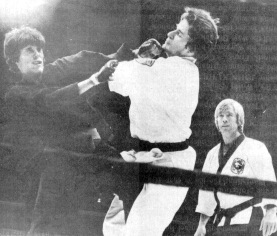
Norris died two days ago in Hawaii after a "medical emergency." It's not clear what happened, as his family is understandably asking for privacy. He was 86. Given his devotion to training, fitness and clean living, everyone assumed he would live to a hundred or so. (See the photo above. This was taken less than a year ago.)

In summation I'll leave with a dose of humor. There are so many of these (of which the man himself heartily approved of), let's go with this one: "There are no bridges named after Chuck Norris. Because no one crosses Chuck Norris."

Labels:

Friday, October 08, 2021

Magic

Lately, on martial arts threads I see online, it seems that traditional martial arts (TMA) have fallen out of favor. Apparently if you're not training for life-and-death or the Octagon, you're spinning your wheels. But in the idealistic past we've had TMA heroes gracing the big or little screen that seemed larger than life. Bruce Lee, Chuck Norris and the TV show Kung Fu inspired us. It was David Carradine's portrayal of Caine, the Shaolin monk turned cowboy that inspired me to bug my parents to enroll me in my first martial arts class. Carradine was not really a kung fu practitioner of note, but that didn't matter to me. Norris once quipped that Carradine was about as qualified a martial artist as he (Norris) was a gifted stage actor, but I digress. Both of them presented martial arts in a very positive way. I miss that. And in its place we have to witness internet squabbles over full-contact sports like Muay Thai and judo, versus aikido, wing chun, tae kwon do, karate, or any other TMA du jour that's on the radar of these basement-dwelling chat-room pseudo cage fighters when they should be out looking for a job. To be fair, not all critics fall into this category. But then, the qualified critics, those with real combat, security, or fighting experience, (usually) can't be bothered airing their grievances on reddit. 

In 1984, The Karate Kid movie became a surprise hit. And in its wake, martial arts schools flourished. Enrollment doubled and tripled overnight, especially with kids, but what made this movie unique was the feature of the tournament. So between charging for lessons, belts and tournaments, karate school owners raked in the bucks. It's my opinion that kata and point-matches for trophies and colored belts have been both good and detrimental to karate. By the early 90s MMA came to the US, courtesy of a Brazilian clan's rendition of jiu-jitsu. A corner was turned, and there was no going back. 

In the old days, TMA were held as magic. We believed, because we had Kato and Lone Wolf McQuade and Mr. Miyagi there to give us faith. They were the good guys. I believed, because I wanted to believe that the style of karate that I espoused gave me a chance to be something greater than I was. Maybe I was naïve. I was young, what did I know? 

Today, critcal thinking reigns, so when we see a video of a "master" knocking out his student via hypnotic gaze, we know better. But these cringey clips, along with qi strikes and 7-year-old black belts, these things by default get relegated to TMA. And that's a shame. Still in spite of it all, the karate that I know, somehow, still possesses something magical.

Labels: , , , , , , , , ,

Friday, July 05, 2019

Neat Tricks

Eric Shahan, a martial arts practitioner who specializes in translating classic Japanese texts into English has translated a treatise on acquiring supernatural powers in a new book, Twelve Rules Of The Sword, that was passed down verbally from a 17th century samurai school. Among other things, the rules for prevailing in combat involves saying two prayers and writing Sanskrit characters on your palms. Could be a tad time consuming when the heat is on. But supposedly the book also discusses some practical strategies for combat, similar to those found in The Book Of Five Rings, which deals more with the psychology of fighting than physical techniques. Training, attitude and situational awareness, while paramount in the martial arts, are far from magical concepts.

In Okinawan karate, performing the kata Sanchin over and over is supposed to develop otherworldly stamina and strength. The ancient form, of Chinese origin, is akin to a dynamic-tension routine that was hawked in comic books by bodybuilder Charles Atlas in past decades. It's a slow motion punch-and-block sequence that mimics pushing and pulling a heavy weight with isometric contractions and forced breathing. Entire books have been written on the single topic of Sanchin. The kata is a staple in many schools of karate, especially Goju-ryu. Its founder, Chojun Miyagi, made his students perform Sanchin many times each day, with the idea that it would transform them mentally, physically, and spiritually. Miyagi himself was built like a bull and purportedly could perform superhuman feats. In one public demonstration in 1924, he...

[T]hrust his hand into a bunch of bamboos and pulled out one from the center. He stuck his hand into a slab of meat and tore off chunks. He put white chalk on the bottom of his feet, jumped up, and kicked the ceiling — leaving his foot-prints on the ceiling for all to see. Spectators hit him with long bo (staffs) with no effect. He tore off the bark of a tree (with his fingers). And with his big toe he punctured a hole in a kerosene can...He did many more feats which had to be believed.*


These types of feats today are rare. Most modern demos involve crowd-pleasers like self defense moves and board breaking. Gymnastic feats like tricking or parkour (the latter which is derived from military obstacle course training) flood the internet. Most recently we have the Bottle Cap Challenge, originally uploaded by Farabi Davletchin, a champion taekwondo fighter from Kazakhstan. The trick involves setting up a bottle of some beverage roughly chest high, and executing a variant of a spinning hook kick which grazes the pre-loosened bottle cap, spinning it off the top while leaving the remaining bottle untouched.

Everyone seems to be getting in on the action with their own clips, including famous martial arts actor Jason Statham (see above). Pretty impressive for a guy over fifty. If Chuck Norris were a bit younger he would have a go at this. Hell, maybe I'll give it a shot. Still, Miyagi would probably outdo everyone with his barefoot hole-in-the-kerosene can move. Then again, Miyagi also said at the conclusion of his demo, "Karate is a total commitment. I have not done anything that someone else cannot do, or, for that matter, you. There is no halfway measure. Either you do it or you don't. Nothing is impossible."

Indeed. There is no magic.


* Richard Kim 1974. The Weaponless Warriors. Ohara Publications. (Originally written by journalist Tojuda Anshu.)
† Want to feel old? Norris will be eighty next year. Can you believe it?

Labels: , , , , , , , ,

Sunday, June 21, 2015

Faking To Win

In those days, when Japanese stylists threw a kick they never faked or feinted — the kick went straight to the target. They were not accustomed to someone faking a kick to one area and landing it elsewhere.

— Chuck Norris on sport-karate strategy, c. 1967.*


In Wansu kata, the fourth karate form taught in Isshinryu, at some point the defender executes an uppercut immediately followed by a front kick. I have been told that Shimabuku referred to this maneuver as "bullshit", i.e., the uppercut is just a fake setup for the real damage inflictor, in this case the front kick. A very similar strategy can be found in the Kusanku kata: backfist to the face while simultaneously executing a foward-leg front kick. Check out the image below of Ed McGrath attempting this very trick for his black belt test against his instructor Don Nagle in 1959:


McGrath paid for his efforts with a broken nose, but he did earn his shodan in Isshinryu. In MMA there's something called a "Superman Punch" that involves the player faking a jump kick followed by an airborne punch to the face. Although less "fake-ish", another variation of this has the attacker catapulting off the side of the cage to deliver the flying haymaker:


In karate, a faked front kick (or foot sweep) followed by a round kick to the head works well, speaking from experience. Fakes or feints should be used sparingly and look realistic enough to elicit a response; once the opponent has committed to reacting to the faux move, the live technique can then be delivered. To sell the fake technique requires speed, timing, range/distance (ma-ai), and being able to read the opponent.


* Chuck Norris 1989. The Secret of Inner Strength: My Story. Charter Books.

Labels: , , , , , , ,

Sunday, August 10, 2014

The Isshinryu Front-Kick: Varieties, Chambering and Distance

The front-kick is the most basic kick taught in karate, tae kwon do, or just about any striking style in martial arts. To execute, the knee is pulled up to waist-level (chambered) while the shin hangs down. The leg is then straightened to strike the intended target. Novices are taught to kick the midsection, but other targets include the shin, thigh, groin, or even head. In tournaments, Chuck Norris would fake a front kick to the gut, retract, then snap it to up the head for an easy point. Most practitioners either aren't that quick (or flexible), or prefer other kicks that are less detectable such as roundhouse, hook, crescent, and spin-around-back.

Sensei Victor Smith has a nice article on the front-kicking techniques of Tatsuo Shimabuku (the founder of Isshinryu karate). Some old video clips of the master (c. 1960) are posted featuring the mae geri (front kick) from the Isshinryu kata canon. As Smith-san notes:

If we have been observing his [Shimabuku's] technique,

1. First he raises his thigh parallel to the floor.
2. Once the leg is chambered parallel to the floor, the leg kicks out and returns in a hinging motion, front front kick or rear front kick.

This kicking method means the foot strikes out from the chamber and not slingshoting out as the leg/knee rises.

It gives less time for the opponent to recognize the kick is coming. That also means there is less time to try and catch the leg.

His remark "less time to recognize the kick is coming" raised my eyebrow at first. If I see my opponent has his leg chambered of course he is going to kick me, was my initial thinking. But from a chambered leg (with the shin held at 90-degrees) I have no idea which kick is coming. A chambered leg could be the prelude to one of the following:

  • Front kick
  • Roundhouse kick
  • Hook kick
  • Side kick

A "slingshot" style kick could be a telegraph if you're really sharp. Don Nagle, who trained under Shimabuku in the late 50s, supposedly could block a kick as it was rising from the floor with his forward foot! Now that's a neat trick. Personally, I'm too reflex challenged to pull this kind of move off. I've never seen anyone even attempt this. Attempts at catching kicks I've seen plenty, usually among beginners. In some dojo I've trained in catching an incoming kick is seen as taboo, even though (or maybe because) MMA players do it all the time. The time-honored way is to slip the kick (ideal) or block it with your arm. (The latter is widely taught in karate. Disclaimer: bad idea.) At any rate, I believe that chambering most kicks is good practice. As a last resort the raising knee could be delivered as a hiza-tsui (knee-strike) if your attacker manages to close the distance.


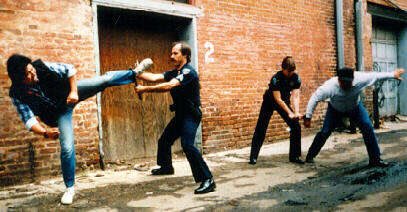
The last video in the blog shows a very brief clip of the master performing what appears to be an application from the kata Sunsu, his creation and a form particular to Isshinryu karate. It is a front thrust kick (as opposed to the snapping variety) in defense of a double-arm grab. (The image above illustrates present-day exponents demonstrating this.)* In this scenario ma'ai or striking distance is minimal between you and the attacker. In this manner, the thrust "kick" is performed more like a push-off.

Generally, the front thrust kick is a very different animal from the more widely taught front snap kick in traditional karate. A front snap kick utilizes mostly the vastus medialis portion of the quadriceps muscle and requires a quick recoil, striking with the ball of the foot (If you're wearing footwear as most folks do when out and about, the ball-of-the-foot application becomes moot, but I digress.). A front thrust kick is akin to kicking down a door; you're really driving more with your hips and striking with your heel. Thrust kicks have more knockdown power than snap kicks. A staple in Muay Thai kickboxing, the front thrust kick has been favored among the Japanese military for use in combative self-defense.


The front kick, a basic technique that is relatively easy to execute, has viable self-defense applications and variations that shouldn't be given short shrift in lieu of so-called flashier kicks.


* This particular bunkai of Sunsu is how it was originally taught to me by a high ranking instructor who trained on Okinawa. I believe it's the correct way. Since then I've visited a number of schools through the years seeing other things applied. It seems everyone has their own version of Isshinryu.

Donn Draeger 1974. Modern Bujutsu and Budo. [p. 75-76] Wheatherhill, Inc.

Labels: , , , , , , ,

Sunday, July 22, 2012

The Fast Track to High Rank

Someone I know just received their black belt in Brazilian jiu-jitsu. It took him ten years, and I'm told this is the typical amount of time it takes in this style. Most martial arts as practiced in the US take about half that time to achieve the coveted black belt. Perhaps BJJ has higher standards or their people want to disassociate with those of the McDojo variety that award black belts at breakneck speed.

There seems to be some controversy over the length of time it should take to get to black belt. (A word to the wise: it's not a good idea to ask "how long will it take to get a black belt" at a traditional school.) Isshinryu karate's Angi Uezu says it takes, on average, about two-and-a-half years on Okinawa. In the All-Japan Karate Federation (formerly, the Zen Nippon Karatedo Renmei), three years is recommended to achieve shodan (1st degree black belt).* It took Chuck Norris fifteen months, kickboxing great Joe Lewis seven months and Isshinryu legend Don Nagle six months to get their black belts while training in Korea or Okinawa during a US military hitch.


Isshinryu's founder, Tatsuo Shimabuku, would grant dan level ranks to certain US servicemen who trained under him rather quickly, knowing it would be years before he would see them again. The Karate Questions and Answers blog has more to say about this. Elsewhere, a Marine who trained under the master in the late fifties recounts that


It took six or seven months to make green belt, and a couple more to make black. He [Shimabuku] didn't give a certificate to Americans until they left Okinawa. At first he gave low grades, but the students persisted until he began to give high grades for a minimum time. One American was given an eighth dan (black belt rank) after only two and a half years in isshin-ryu, while another made seventh dan after one and a half years. To justify such ranks, Shimabuku would say "You'll rate it in 15 or 20 years." He gave higher grades because he thought most Americans would not be returning to Okinawa...

Nevertheless, when the Americans returned to the United States from Okinawa, most did not wait 15 or 20 years, but proclaimed their high grades immediately.


When speaking of the duration of white belt to black belt the only relevance is actual training time in the dojo. One source cites that at least 1000 hours of instruction is required for promotion to 1st dan black belt. If you train 1 - 1.5 hours per class three times a week, that works out to about five years. Norris, who first took up judo in the Air Force and then switched to tang soo do (a cognate of tae kwon do) while stationed in Korea, would train up to thirty hours per week, about double of what most Americans train in a month. Initially, he didn't even think about getting a black belt. Apparently, he figured out something very important: It's the journey, not the destination, that counts.


* Richard Kim 1974. The Weaponless Warriors. Ohara Publications, Incorporated.
Jennifer Lawler 1996. The Martial Arts Encyclopedia. Masters Press.

Labels: , , , , ,

Saturday, May 10, 2008

The American Way


I used to have a gi with the American flag sewn on the sleeve. The caption read Martial Arts - USA as if this were some new paradigm. Maybe it is. Somewhere along the line the martial arts became a bona fide American institution, like baseball, apple pie and labor unions. But do American budoka measure up to their Asian originators? Has the US or anywhere in the West produced the likes of a Kano, Funakoshi or Shimabuku? Donn Draeger, who studied for many years under Japanese sensei, felt that for a classical martial system to be preserved justly, it must include the manners, customs and beliefs indigenous to that style's nation of origin.

So then what aspects of American culture influence our interpretation of the martial arts? Are we doing them any justice? Draeger had doubts about this, defining The American Way as ultimately "lazily convenient." We like to think we all train hard. And we're accustomed to the formal etiquette practiced in nearly all dojos, especially the all-important aspect of rei (respect). Respect is apparently lacking in our culture, certainly more now than in the past. One only has to witness the disrespect that is present in the workplace and public schools.

Gichin Funakoshi felt that a karateka should at all costs be a decent citizen and a role model for society. To that end most schools adhere to a special code of conduct called a dojo kun which outlines a list of goals and behavior a good practitioner should strive for. Here's two precepts from Chuck Norris' code taken from his chun kuk do system:

  • I will maintain respect for those in authority and demonstrate this respect at all times.

  • I will always remain loyal to God, my country, family and my friends.
Notice how religion and nationalism come into play in the second one. Should these icons be included within the context of martial arts training? When Okinawan karate first arrived in Japan around 1920 it became infused with Japanese ideologies, which included militarism, Zen, and yamato damashii - the "Japanese spirit". Some Okinawans were unhappy with these changes, but karate's move to mainland Japan was but a prelude to its worldwide acceptance and popularity. Equally, when the martial arts arrived here in the US they became Americanized to a degree. Did this necessarily devalue them? I don't believe so. If you're a sincere, committed student in the right school then coming to terms with these cultural infusions can be transcended, if they matter at all.

Labels: , , , , , ,

Sunday, September 02, 2007

That's Entertainment!


For the most part, the martial arts are divided into striking and grappling categories. Both of these major systems have been interwoven into the relatively new paradigm of Mixed Martial Arts (MMA). MMA contests often go quickly to the ground, and in this fashion players "tap out" to signal they've had enough, or they're simply rendered unconscious courtesy of a strangulating choke-hold and it's game over. But without launching into a debate about whether MMA are really martial arts, combat sports or whatever, I'd like to address their entertainment value. MMA are being touted as the next big thing in sports and have already become more popular than professional boxing. This is big news, since prizefighting has long held a solid position in worldwide culture, especially in the West. What it all comes down to is this: Would you rather see a standup fight, or a submission-style MMA match? Somehow an armbar, no matter how effective it is, doesn't quite measure up to the visual dazzle of somebody dropping an opponent with a crushing right cross or reverse punch delivered to the jaw.

Does anyone remember the John Wayne classic The Quiet Man? The Duke partakes in the most famous - and perhaps the longest - fistfight in cinematic history against Victor McLaglen's character. The last time I saw a real-life grappling match of similar epic proportions was when Royce Gracie defeated Dan Severn in the Ultimate Fighting Championship (UFC 4, 1994). Gracie, outweighed by eighty pounds and on his back for almost the entire bout, still managed to pull it out with a miraculous triangle choke-hold with his legs applied to the neck of the gigantic Severn. Truth be told, up until the very end, the history-making match was a snoozefest. While judo, jiu-jitsu et al, are considered to be "combat effective" arts, their matches are comparatively boring to watch.

During most of his career, Chuck Norris has had the Midas touch - until recently. His World Combat League (WCL), a team-based kickboxing federation, has received only modest cable TV ratings. While UFC pay-per-view events and the like are generating millions, Norris' WCL is barely able to pay the bills. Advisors to Norris are telling him that the heyday of standup martial arts are long over and that he should be glad for the small amount of viewership that he's getting.

So what we may have here is a generation gap in fighting culture. Old school adherents like to stand on their feet and knock out their foes while the new wave proponents are becoming skilled strikers and ground technicians. There does exist certain styles that utilize joint locks in a standup fashion that are highly effective that are discussed in this post by Dojo Rat, but I digress. At any rate, the martial arts continue to evolve along with the public perception of what is most interesting and entertaining about them.

Labels: ,

Monday, July 02, 2007

Give Me A Break


The young US airman had been studying the martial arts for several months when his sabum announced to the class that they would be performing a demonstration at the public square. A large crowd of people stood and watched in the small Korean village as the first event commenced. The master spoke briefly to the villagers about the art of tang soo do before he called upon his first charge. The nineteen-year-old airman felt honored to hear his name announced to demonstrate his ability to break a stack of roofing tiles with his bare hand. He stood up nervously and walked over to the small platform where the tiles were placed. His heart was now racing with anticipation as a hush came over the crowd. He visualized annihilating those formidable looking tiles that seemed to be stacked a mile high. He knew he had to nail this on the first try - there would be no second chance. This was it. He raised his hand, and with all the ki energy he could muster he fired his fist down with incredible speed. The tiles didn't budge. Chuck Norris had just broken four knuckles in his right hand.

Breaking has always been a crowd pleaser at martial-art demonstrations. No karate or TKD demo is really complete without the obligatory sidekick or shuto (knife-hand) busting apart some inanimate material. Planks of wood (white pine is a favorite) and even slabs of ice have been the objects of choice at many demos. Even the Karate Kid had his turn at the frozen stuff.

For the less inclined would-be breaker, the convenience of using Breakaway boards - plastic molded panels that have interlocking seams that allow them to be reused - offer all the glory of mayhem without having to end up in the X-ray room. The ones that I've seen use a color-coding scheme; yellow being the least resistant, on up to black for the heavy hitters. Still, don't try this at home.

Mr. Miyagi's tactic of shearing the tops off of three beer bottles at once to fend off bullies was a neat trick. Kyokushin karate founder Mas Oyama routinely performed this stunt at demos with just one bottle. When one of his students attempted the same feat he almost lost his little finger. Oyama's other infamous knack for using a shuto to chop off a bull's horns would have undoubtedly invoked the wrath of animal rights activists today. I think pitting Oyama against a group of unruly protesters would've been much more fun to watch.

Some schools use board breaking as a requirement for belt promotion, the idea being that a good break should be equated with causing great injury to your opponent. Otherwise, yourself. Just ask Chuck Norris.

Labels: ,

Wednesday, April 11, 2007

Making The Grade


Only One In 10,000 Make It To Black Belt - Be That One! This is what I read in a flyer that I saw at a local karate school recently. One in ten-thousand - does that sound right? That's what I'd call lying with statistics! If we're talking about the total number of martial-art students who enroll in a school, I'd say one in about two-hundred eventually succeed in achieving shodan (1st degree black belt). Even so, one-half of 1% is still a pretty small slice of the pie, which puts the Black Belt Club in an elite group. An instructor of mine once commented that becoming a black belt is an honor that exceeds that of becoming an attorney or a physician. I don't have any figures available, but I'm guessing that far more than 1% of prospective lawyers and doctors pass the bar and graduate from medical school respectively.

The martial path is real tough in the right school, and the black belt test is far from a shoo-in, even for the qualified candidate. Chuck Norris failed his first attempt at black belt. One young man I knew who was testing for shodan quit midway through the sparring portion of his exam. He was fighting well through several matches when he inexplicably threw in the towel. In the weeks leading up to his test he had gotten so worked up that when the big day finally arrived, his fear of failure became a self fulfilling prophecy. Fortunately, one of the senior instructors had a talk with him and was able to bring him back out onto the mat to finish and pass his test. It ain't over till it's over.

If you've managed to stay with the martial arts for just a few years you're probably in awe of the fact that so many people come and go. The martial arts are not for everyone, and as a result there's a revolving door at most schools regarding students. But you never know who has what it takes, and sometimes the most unlikely trainee will fool you and go the distance. The martial arts are about transformation. As somebody once told me, you don't get a black belt, you become one.

Labels: , ,

Saturday, February 17, 2007

Do I Feel Lucky?

Are you learning or know how to disarm an attacker with a weapon? The featured weapon of choice in most martial-art schools is the receiver-friendly rubber knife. Most novice trainees have been shown at least a couple of basic knife disarming techniques. To be honest, some of these moves are predicated on the notion that the knife wielder has no clue how to properly handle their weapon. The way of the knife is an art. Elite military personnel take their knife fighting skills to a level that would render most McDojo self-defense techniques utterly useless. The saying "never bring a knife to a gunfight" should be a reminder that everything is relative. How would an unarmed martial artist fare against a gunslinger? Would you actually consider trying to take out somebody brandishing a Glock 22 or a .357 Magnum? The following is in part an excerpt taken from The Secret of Inner Strength: My Story, by Chuck Norris with Joe Hyams:

David Glickman, a prominent defense attorney from years ago, asked Chuck Norris to help out with a murder trial he was involved with. The story is that the defendant arrived home from work early one day to find his wife in bed with another man. The husband immediately retrieved a gun from a dresser drawer. Jumping out of bed, the lover charged him. The dutiful husband, who knew that this man was a black belt in karate, shot and killed him. Glickman's plan of defense was to show that a karate expert's skill should be considered lethal. Therefore, the husband acted in self-defense. Norris was called to the stand as a professional witness on behalf of the defense. He was then cross-examined by the assistant district attorney.

DA: Do you expect the court to believe that a black belt in karate would have a chance against a man with a gun?

NORRIS: It's possible. It would depend on the distance.

DA: How about ten feet?


NORRIS: If the gun was not already cocked and aimed, I believe it is possible.

At this point, the DA asked Norris to step down from the stand and wait in front of the jury. The DA produced an unloaded gun and showed it to the jury. Standing next to Norris, he then paced off ten feet, as if reenacting a duel.

DA: I'd like you to stop me before I can cock and fire the gun.

Acting on instructions from the DA, the bailiff shouted "Now!" Like a flash of lightning, Norris sped across the courtroom and placed his foot on the DA's chest. Norris thoughtfully pulled the full power of the kick to avoid hurting the prosecutor.

DA: My thumb slipped. Let's do it again.

This is our tax dollars at work. Norris, standing relaxed with his hands at his side, waited for the command. When the bailiff gave the word, Norris once again closed the distance at light speed, gently planting his foot on the chest of the DA before the gun was cocked. As if that wasn't enough, Norris, with the help of an assistant, proceeded to break some boards to demonstrate the power of karate kicks. The defendant was acquitted.

What's interesting is that in certain cultures the husband's actions would have been seen as totally justified. Naturally it could be argued that had the husband not reached for a gun, the adulterous black belt would have had no reason to jump him. If anyone was acting in self-defense, it was the karate guy. If your martial arts instructor is showing you how to disarm an attacker with a gun, tell her/him about this story. Remember, only Superman is faster than a speeding bullet. And of course, Chuck Norris.

Labels: , , ,

Saturday, January 06, 2007

Fear of Fighting


The young competitor was sick to his stomach. He made a last dash to the bathroom before his name was called. Here he was, a newly promoted black belt at one of the biggest tournaments in the US, fighting an even bigger name - an ex-serviceman with an impressive record who had started his training in Korea. "Don't worry, you'll do just fine", his adversary promised with compassion rarely displayed at a karate event.

Many people come to the martial arts because they abhor the idea of fighting, and simply want to learn some practical self defense. "I hate sparring" is actually a fairly common utterance in some schools. Part of this is due to the fact that kumite is taken personally by certain players who feel a need to prove their dominance over others. The stock warning issued by one instructor I used to know - "lighten up or I'll show you how hard I hit" - only served to reinforce the macho tendencies that were already well established. I've seen a number of decent students leave karate because of runaway sparring matches and indifferent coaching practices. Although anything can happen on the street , there has to be some semblance of fairness in the dojo.

The body is constantly eavesdropping on our thoughts and responds accordingly. Fear is negative energy that takes its toll on us physically; its debilitating effect produces fatigue. Another by-product of fear is shallow, labored breathing. While emotions do affect the quality of respiration, the opposite is also true: proper breathing can re-stabilize our emotions. Taking a slow, deep breath to calm the nerves before sparring or testing can be very effective.

Legendary boxing coach Ray Arcel once noted that no matter how confident a fighter may appear before a bout, there is still some remnant of fear beneath the image of toughness.

As for our nervous karate fighter at the big tournament - he ended up winning after all! And it would be the last time Chuck Norris would give friendly advice to someone he was about to do battle with. Never underestimate anyone, including and especially the fearful.

Labels: , , , , , ,

Friday, November 17, 2006

The Natural


Chuck Norris once remarked that he preferred to coach a student with shortcomings in ability, as opposed to the trainee who is inherently talented. Some are more inclined to do martial arts than others, and this is true with all endeavors. On the average, it takes five to seven years to achieve a black belt in most systems, but there are those who can do it in considerably less time. Norris tested for black belt after a year, but it should be pointed out that his tang soo do sessions lasted five hours and were held six days per week. Paying dues through arduous training is part of the martial way. Woody Allen's rule that "80 percent of success is just showing up" really applies to just about anything one wishes to pursue. Sometimes discipline is just being able to arrive at the dojo.

Should someone be allowed to move up through the ranks quicker than the next person just because they're more naturally inclined? The idea of having a novice around who gets techniques down pat on the first try, and can whip most of the people in the school (regardless of rank) doesn't always go over big. Don Nagle, as a white belt stationed on Okinawa during his US military stint, routinely razed local black belts in kumite. This gave tremendous credibility to his teacher and the maverick style of Isshinryu, but truth be told, Nagle probably would have excelled in any karate style.

There's no guarantee that innate ability will carry you far in the martial arts. The opposite is also true: Perceived liabilities cannot hold anyone back. We all have talents and special abilities that are meant to be realized and shared. Even if we're not the best at what we do, we each have a distinct way of expressing that which makes us unique. But being prodigious at something usually comes at a cost. Nagle's sensei, Shimabuku, advised him to stop visiting other dojos to issue challenge matches. He wasn't welcome there anymore.

Labels: , , , , , , ,

Friday, September 22, 2006

Training For Power


Waza (technique), and its precise execution, is such a vital aspect of the martial arts in that it allows a smaller, physically weaker person to prevail against a larger, stronger antagonist. Still, in spite of this statement, physical strength has its place, and under certain circumstances can go a long way for the practitioner. This is in no way to discredit the effectiveness of using proper form in techniques, nor should this principle ever be dismissed. But I believe that any physical endeavor, including martial arts training, should include a regimen of weight training to develop strength.

At one time, strength training with weights was considered taboo for the athlete. With the exception of football players, competitive weightlifters and bodybuilders, athletes were strictly advised to avoid lifting weights. One myth attributed to weight training is that it compromises speed and flexibility - two sought after qualities in the martial arts. Flexibility is the result of proper stretching, which should be done daily and is especially recommended before and after a martial arts session. Speed is acquired through training for that capacity, and can be developed alongside of a strength training routine without one interfering with the other.

During Okinawan karate's early development, ishi-sashi were used in a fashion similar to using dumbbells. These hand-held stone devices were carried as the practitioner performed kata and various strikes. In the 60s, martial arts historian Donn Draeger was one of the first to suggest a weight training program for judo players. In addition to Draeger, Chuck Norris and Bruce Lee were advocates of weight training for martial artists at about the same time.

Besides making muscles grow, weight training causes bones to become denser, offsetting the possibility of osteoporosis late in life (prevalent in women). Added muscle also creates a more efficient metabolism, capable of burning fat at rest (as opposed to a cardio workout, which only burns fat while training). Today, it is a rare athlete that doesn't employ some kind of progressive resistance training.

Labels: , , , , , ,

Saturday, June 17, 2006

Police Action


Cops have it rough. Law enforcement agents of every kind must find a delicate balance between dealing with the bad guys and self restraint. One cop I used to know (a black belt) once told me that many years of martial arts training does not always compensate for what goes down in just one day on a New York street. Chuck Norris, stationed at a US Air Force base in Korea as a military cop in the early 60s, dropped a rather large drunken Sergeant in a barroom melee with a single front snap kick to the groin. Crime really doesn't pay.

A modified version of self defense is taught at law enforcement training facilities, but with the provision that the would be defendant can walk into a jail cell in one piece. A police baton was re-designed to resemble the tonfa (an Okinawan rice mill lever) - a nightstick with an appendant short handle attached perpendicular to the main body of the weapon. But it was abandoned when cops found it so unwieldy to use. Cops must feel like they have their hands tied when dealing with dangerous types. When subduing a criminal, for example, choke holds are strictly prohibited, and obviously for good reason. Of course, this all runs counter to what the martial arts were originally designed for. The good guys are expected to play by modern rules.

Labels: , , , , ,